Top Garden Irrigation Brands in the UK: How to Compare Systems in 2026
Compare UK garden irrigation brands by tap fit, zones, connectivity, offline control, watering rules, support and total ownership cost.
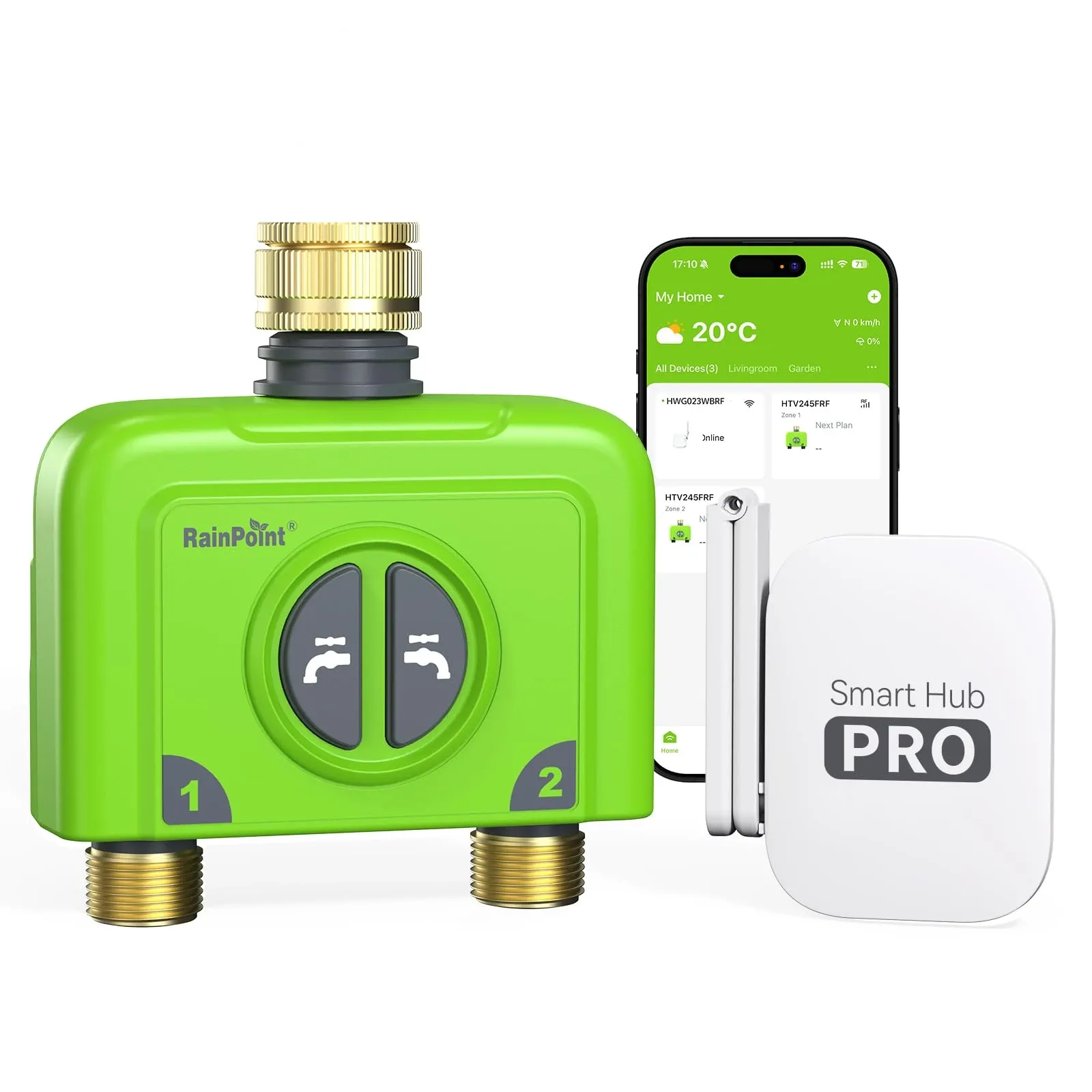
The best garden irrigation brand is the one whose system fits your tap, pressure, zones and daily routine - and still lets you water sensibly when the phone, cloud or broadband is unavailable. Brand recognition is useful, but compatibility and failure behaviour matter more than a long app feature list.
A better way to compare irrigation brands
UK buyers often begin with RainPoint, Hozelock, Gardena, Orbit/B-hyve or a marketplace timer, then get stuck comparing unlike products. One range may focus on simple tap timers, another on connected hubs, another on modular micro-drip parts. A fair comparison starts with the job, not the logo.
Write down these five facts before opening product tabs:
- The outdoor tap thread or adaptor you actually have.
- The number of independently timed watering zones.
- The water source: mains tap, water butt, pumped tank or fixed irrigation supply.
- The furthest distance and walls between the controller, hub and router.
- Whether watering must continue when the internet is down.
That short brief prevents an expensive smart controller from being used as a basic clock, or a cheap timer from being expected to manage a greenhouse and lawn independently.
Brand types and where they tend to fit
| System type | Best for | Questions to ask before buying |
|---|---|---|
| Simple mechanical or digital tap timer | One hose, low setup effort, no app dependency | Minimum pressure, run frequency, manual override, battery warning |
| Hub-connected smart timer | Remote control, multiple schedules, alerts | Hub power, radio reach, account dependency, offline schedule storage |
| Wi-Fi controller without a separate hub | Router is near the garden entrance | Signal through masonry, reconnection behaviour, local manual control |
| Modular micro-drip ecosystem | Pots, beds and greenhouse layouts that will grow | Emitter compatibility, spare parts, filters, pressure reduction |
| Fixed multi-zone controller | Larger planned systems and buried valves | Installation, transformer, valve compatibility, winter service |
This is why a single “best brand” ranking is misleading. A gardener with six balcony pots has a different reliability problem from someone splitting a greenhouse and lawn across two outlets.
The eight comparison tests that matter
1. Tap fit and leak control
Confirm the supplied connector and any reducer before ordering. Plastic threads should start by hand without force. A timer that needs a chain of improvised adaptors is harder to keep watertight and more vulnerable to movement.
2. Pressure and flow
Check the manufacturer’s stated operating range and remember that a water butt without a pump can deliver much less pressure than a mains tap. The controller may open correctly while emitters at the far end barely drip. Test the complete line, not only the valve.
3. Independent zones
Two outlets only add value when each can have its own schedule. Pots, lawns and greenhouse beds lose water at different rates. Look for independent start times, durations and manual operation rather than a splitter that duplicates one programme.
4. Connectivity through the real house
Solid brick, foil-backed insulation, metal doors and distance can matter more than the app’s screenshots. If a hub is required, identify its indoor socket and likely path to the outdoor controller. A good returns window is useful because no specification sheet can reproduce every house.
5. Offline and manual control
Ask what happens after a broadband outage, cloud service interruption or phone replacement. Does the last schedule remain stored on the controller? Can each outlet be opened manually? Will the valve fail open or closed when power is low? Prefer documentation that answers these questions directly.
6. Weather and rain features
“Rain delay” may mean a manual pause, a sensor input or a cloud-weather automation. Those are different functions. Do not assume a weather forecast is connected unless the documentation names the mechanism and explains what happens when data is unavailable.
7. Spares and long-term support
Compare replacement washers, connectors, filters, batteries, hubs and downstream fittings. A cheaper valve can cost more if a small damaged part means replacing the whole system.
8. Privacy, subscriptions and account dependence
Read whether an account is mandatory, what data the app uses and whether core scheduling has a subscription. If the product page is silent, treat the answer as unknown and ask the seller.
Where RainPoint fits
The current RainPoint two-zone controller is aimed at gardeners who want two independently controlled outlets, app access and a gateway while retaining manual control. Verify the live page for the current pressure range, included parts, battery requirements, warranty and basket price because those details can change.
It is a stronger fit when two watering jobs need different schedules and an indoor location for the hub is available. It is a weaker fit for a gravity-fed water butt without confirmed pressure, more than two independently controlled zones, or a household that wants no account or radio gateway at all.
The important point is not that one badge wins. It is that the product architecture matches the garden.
A 48-hour commissioning test
Run this before relying on any connected timer during a holiday:
- Fit fresh batteries and label outlet one and outlet two.
- Dry-fit every connector, then pressurise and inspect for leaks.
- Run each zone into a measured container for the same short period to expose large flow differences.
- Pair the controller near the hub, then test from the normal garden location.
- Programme two short, separate schedules and confirm both execute.
- Turn off home broadband briefly only if the manual permits; confirm the documented offline behaviour.
- Use the manual override at the controller.
- Leave the system pressurised only as instructed and inspect every joint again the next day.
Record the result. “The app connected once” is not a reliability test; two scheduled runs without intervention is a much better minimum.
Water restrictions change the decision
A timer does not create an exemption from a Temporary Use Ban. Water UK says restrictions and exemptions vary by water company and affected area. Check the current rules with your own supplier before using a hosepipe, drip line or automated controller. Buckets and watering cans are generally treated differently, but local rules control.
This matters in 2026 because the legal and practical value of a smart timer can change during a restriction. A controller can still help plan permitted watering, but automation must not be presented as permission.
Total ownership cost
Compare more than checkout price:
- required batteries and their replacement interval;
- a hub or power adaptor;
- extra tap adaptors, pressure reducer or filter;
- enough tubing and emitters for the intended zones;
- replacement washers and winter storage;
- subscription cost, if any;
- the cost of plants if an unreliable schedule fails.
The smart water timer guide covers controller features and helps place the timer inside the wider pipe-and-emitter layout.
Common mistakes
- Choosing by app rating without checking tap and pressure compatibility.
- Treating two physical outlets as proof of two independent schedules.
- Assuming “smart” means automatic weather decisions.
- Leaving for a holiday immediately after installation.
- Hiding the hub behind thick masonry and blaming the outdoor valve.
- Forgetting frost draining and winter storage.
- Assuming a hosepipe restriction does not apply to automated watering.
- Relying on old prices or warranty wording instead of the current product and returns page.
Frequently asked questions
Which garden irrigation brand is best in the UK?
There is no universal winner. Choose the ecosystem that matches your tap, pressure, zone count, connectivity and preferred level of app dependence. Then compare offline behaviour, spares, support and returns.
Is a smart timer worth buying for a small garden?
It can be when schedules change often, the garden is unattended or two areas need different timings. A simple timer is often better when one hose and one repeat schedule are enough.
Do I need a hub?
Some systems use a hub to bridge the outdoor controller to the home network; others connect differently. A hub can improve radio design but adds power, placement and pairing requirements. Check the exact model architecture.
Will irrigation continue if the internet fails?
Only the manufacturer’s documentation can answer for a specific model and firmware. Prefer systems that state whether schedules are stored locally and provide a physical manual override.
Can I use a timer during a hosepipe ban?
Do not assume so. Check your water company’s current Temporary Use Ban rules and exemptions. Product ownership is not legal permission.
Bottom line
Compare garden irrigation brands as systems, not badges. Fit, pressure, independent zones, offline behaviour and a real commissioning test predict satisfaction better than a crowded feature list. Buy only after you can explain how the system waters, how it fails and how you will recover when a battery, hub or network is unavailable.